
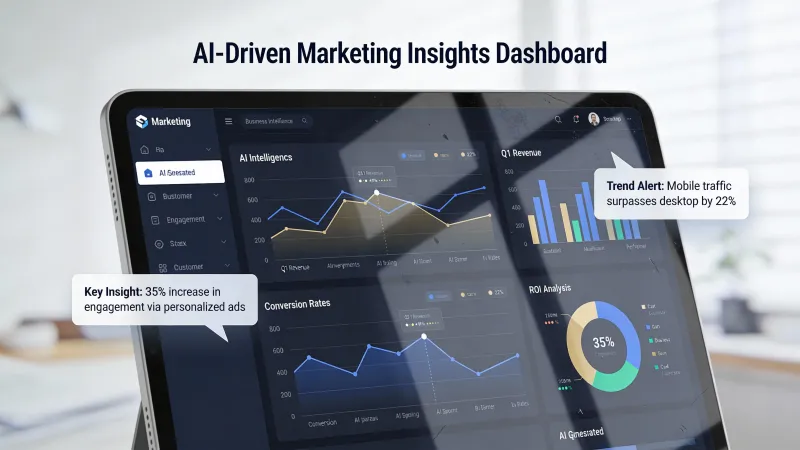
You have a spreadsheet open. Thousands of rows. Campaign performance, customer behavior, revenue by segment. The data is there. The insight is hiding somewhere inside it.
Most marketers didn’t study statistics. They didn’t learn SQL in school. But the job now demands they extract meaning from datasets that would have required a dedicated analyst ten years ago. 88% of marketers now use AI tools daily, and data analysis ranks among the top use cases. The promise is simple: ask questions in plain English, get answers without writing code.
The reality is messier. These tools deliver real value in specific situations. They also fail in predictable ways that most marketing content won’t mention. Understanding both sides matters more than picking the right vendor.
What Actually Happens When You Upload a Spreadsheet
The mechanics are straightforward. You upload your data. The AI reads it, usually through Python and the pandas library running behind the scenes. You ask a question in natural language. The system writes code internally, runs calculations, and returns results in seconds.
This works well for certain questions. “What was our best-performing campaign last quarter?” produces a reasonable answer. “Show me revenue trends by customer segment” generates a chart. The speed is genuine. Tasks that once required waiting for an analyst can now happen in real-time.
But the experience degrades fast when questions get nuanced, when data has quirks, or when business context matters. As one blogger documented after testing ChatGPT on LinkedIn data: “The results generated by ChatGPT have been wrong.” The partner mention counts were inaccurate. Text pattern comparisons failed entirely. They ended up doing the analysis manually in Google Sheets, using the AI as a guide rather than an engine.
That pattern repeats across industries. AI handles well-structured, clearly defined analytical questions. It struggles with ambiguity, edge cases, and the messy reality of marketing data.
The Non-Determinism Problem
Here’s something most marketing teams don’t know until they encounter it: ask the same question twice, get different answers.
As one Power BI analysis noted, “Responses are non-deterministic, so you could get different results with the same prompts and context.” This isn’t a bug. It’s how large language models work. They generate probabilistic outputs, not deterministic calculations.
For exploratory analysis, this matters less. You’re looking for patterns, not precise numbers. But for reporting, for dashboards, for anything you’ll present to stakeholders, you need consistency. An AI that gives you different revenue figures on Monday than it did on Friday creates problems no one wants to troubleshoot.
The workaround is verification. Every insight needs to be checked against the raw data. But that verification step often takes longer than doing the analysis manually would have taken in the first place.
Where AI Analysis Actually Helps
Despite the limitations, these tools solve real problems when used appropriately.
Speed on routine questions. “How did email open rates change month over month?” takes seconds instead of minutes. For high-volume, low-complexity queries, AI saves time consistently. Marketing teams report 44% higher productivity when using these tools, saving an average of 11 hours per week.
Pattern recognition at scale. AI can process thousands of data points and find correlations humans would miss. Which customer attributes predict churn? Which campaign elements correlate with conversions? These questions benefit from computational power humans don’t have.
Accessibility. Marketers who never learned SQL can now query data directly. This democratization matters. When insights are locked behind technical gatekeepers, decisions slow down. 51% of organizations can’t track AI ROI or see true business impact precisely because non-technical teams can’t access the data they need.
One Hacker News commenter noted that Perplexity “replaced Google for me. It’s fast, crisp, and reliable” for research queries. The same principle applies to marketing data. For straightforward questions with clean data, AI tools deliver answers faster than traditional methods.
The Black Box and Why It Matters
“LLMs can still hallucinate, providing inaccurate or fabricated information.” That’s not a critic talking. That’s from Microsoft’s own documentation on AI in Power BI.
The problem isn’t that AI makes mistakes. Humans make mistakes too. The problem is that AI makes confident mistakes you can’t trace. When a human analyst gets a number wrong, you can review their methodology, find the error, and fix it. When AI gets a number wrong, there’s no audit trail. No formula to inspect. No logic to follow.
For marketers, this creates a specific challenge. You need to justify recommendations to leadership. “The AI said so” isn’t a defensible position when someone asks why you’re recommending a budget shift. You need to understand the logic well enough to explain it, which often means redoing the analysis manually anyway.
One HN commenter put it bluntly: “You have to verify its answers, and this can be very costly. Deep learning is only useful when verifying say 5 solutions is significantly cheaper than coming up with one yourself.”
Context Is Everything AI Lacks
Your traffic spiked last Tuesday. The AI sees this and might flag it as an anomaly worth investigating. What the AI doesn’t know: a major publication mentioned your brand. A competitor’s website went down. Your sales team ran a flash promotion. A holiday affected buying patterns.
AI sees numbers. It doesn’t see the world those numbers represent.
This contextual blindness shows up constantly in marketing analysis. Campaign performance depends on competitive activity, seasonal factors, news cycles, platform algorithm changes, and dozens of other variables that don’t appear in your data. An AI that analyzes your email open rates in isolation will miss the fact that your deliverability dropped because Gmail changed their spam filters last month.
The insight: AI can identify what happened and predict what might happen. It cannot explain why things happened. That explanation requires business context no algorithm possesses.
The Skills Gap Problem
Only 17% of marketers received comprehensive, job-specific AI training. Another 32% received no formal training at all. This gap shows up in results. Teams that understand how to prompt effectively, how to validate outputs, and how to interpret probabilistic answers get more value than teams that treat AI as a magic answer machine.
Prompt engineering demand sits at 82% while current capability is only 28%. Data analysis demand is at 68% with just 22% current capability. The tools are available. The skills to use them effectively are not.
This matters because mediocre AI use often produces worse outcomes than no AI use at all. A marketer who trusts incorrect AI analysis makes worse decisions than one who admits they don’t have the data. Overconfidence in flawed insights is more dangerous than acknowledged uncertainty.
What Works in Practice
Start with questions, not tools. “What should this AI analyze?” is the wrong starting point. “What decision am I trying to make, and what data would inform it?” leads to better outcomes.
Use AI for exploration, not conclusions. The tools excel at identifying patterns worth investigating. They’re less reliable for producing final answers you’ll act on. Think of AI analysis as a first pass that humans then verify and interpret.
Keep humans on interpretation. When an AI identifies that customers who view three product pages convert at higher rates, a human needs to determine whether that insight is actionable. Does viewing more pages cause conversion, or do people who intend to buy naturally view more pages? AI can’t answer that. Marketing judgment can.
Validate ruthlessly. Any number you’ll share with stakeholders, any insight that will drive budget decisions, any pattern that will change your strategy needs manual verification. The time AI saves on initial analysis gets reinvested into checking that the analysis is correct.
The Honest Assessment
AI data analysis tools genuinely help marketers who use them appropriately. They speed up routine queries. They find patterns humans would miss. They make data accessible to people without technical backgrounds.
They also fail silently, lack business context, produce inconsistent results, and create overconfidence in flawed conclusions. The gap between marketing claims and actual capability remains significant. 75% of teams lack an AI roadmap, and 63% have no generative AI policies in place.
The $47 billion AI marketing industry suggests real value being delivered. But that value accrues to organizations that understand both the capabilities and the constraints. Treating AI as a replacement for analytical thinking produces worse outcomes than using it as a supplement to human judgment.
The spreadsheet is still open. The data still has insights hiding inside it. AI tools can help you find them faster. But the interpretation, the context, the judgment about what to do with those insights? Those remain irreducibly human.
What patterns have you found that AI missed? What mistakes have you caught before they became decisions?