
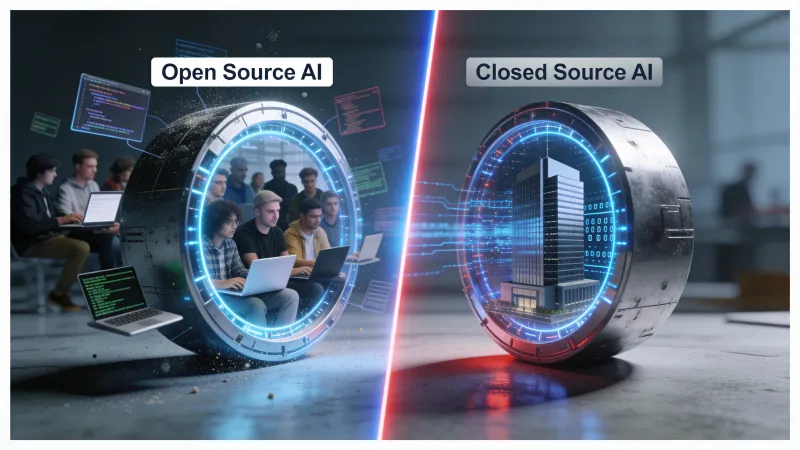
The biggest debate in AI right now isn’t about capabilities. It’s about access.
Should the code and weights behind powerful AI models be public? Or should they be locked away behind APIs, controlled by the companies that built them?
This isn’t an abstract philosophical question. The answer shapes who can build with AI, how much it costs, and who controls the technology’s future.
Here’s what the open vs. closed source battle is actually about.
The Basic Divide
Closed source models keep their internals private. You can use the model through an API (like ChatGPT or Claude), but you can’t see how it works, can’t modify it, and can’t run it yourself. The company controls everything.
Open source models (or more precisely, “open weight” models) release the trained model for anyone to download. You can inspect it, modify it, fine-tune it for your specific needs, and run it on your own hardware.
According to Hakia’s technical comparison, closed models are “AI models whose architecture, training data, and model weights are not publicly available and are owned, hosted, and managed by a vendor.”
The open source side releases some or all of those components publicly.
The Major Players
Closed Source:
- OpenAI (GPT-4, GPT-5, ChatGPT)
- Anthropic (Claude)
- Google (Gemini)
Open Source/Open Weight:
- Meta (Llama family)
- Mistral (Mistral, Mixtral)
- Alibaba (Qwen)
- DeepSeek (DeepSeek models)
It’s not perfectly binary. OpenAI recently released GPT-OSS as an open-weight model. Some “open” models have restrictive licenses. But the basic divide holds.
Why Companies Keep Models Closed
Closed source has obvious commercial motivations, but the arguments go deeper.
Competitive moat. If anyone can download and use your model, what’s your business? API access lets you charge for usage and maintain an edge.
Safety concerns. OpenAI initially withheld GPT-2 over concerns about misuse. The argument is that restricting access prevents bad actors from using powerful AI for spam, disinformation, or worse.
Control and accountability. When you control the model, you can implement safeguards, monitor for abuse, and update to fix problems. Open models are out of your control once released.
Revenue model. Closed models enable usage-based pricing. This has made OpenAI, Anthropic, and Google AI substantial revenue.
Why Others Push for Open
The open source movement has its own compelling arguments.
Transparency. With open models, researchers can study how they work, identify biases, and understand their limitations. According to Klu’s analysis of open source LLMs, transparency enables better safety research and accountability.
Innovation. When anyone can build on a model, innovation accelerates. Thousands of developers can find applications the original creators never imagined.
Accessibility. Open models can run on local hardware. This matters for privacy, for users in areas with poor internet, and for applications that can’t send data to third-party servers.
Longevity. According to n8n’s analysis, “self-hosted models don’t become obsolete, unlike closed-source providers who may ‘retire’ older models.” When a company deprecates an API, users scramble. An open model you’ve downloaded works forever.
Cost at scale. For high-volume applications, running your own model can be far cheaper than API fees.
Meta’s Big Bet on Open
Meta’s approach deserves special attention. They’ve released the Llama family of models under relatively permissive licenses, and it’s changed the landscape.
According to Red Hat’s state of open source AI report, “before DeepSeek gained popularity at the beginning of 2025, the open model ecosystem was simpler. Meta’s Llama family of models was quite dominant.”
Why would Meta give away valuable AI? A few theories:
-
They don’t sell AI services. Unlike OpenAI or Google, Meta’s business is advertising. Better AI helps their products without needing to charge for AI directly.
-
Undercut competitors. If powerful AI is free, Google and OpenAI’s AI revenue is threatened.
-
Build an ecosystem. Developers building on Llama might build things Meta eventually uses or acquires.
-
Commoditize the complement. When AI is free, the scarce resource becomes something else (data, distribution, integration) that Meta might control.
Whatever the motivation, Llama proved that open models could compete with closed ones.
Mistral: The European Contender
Mistral AI, founded in Paris by former Google DeepMind and Meta AI researchers, took a different approach. According to n8n’s analysis, Mistral “changed the open-source landscape when it released Mistral 7B under the Apache 2.0 licence.”
What made Mistral notable wasn’t just that it was open. It was efficient. Rather than chasing raw parameter counts, Mistral focused on architectural innovations that made smaller models perform like larger ones.
Mixtral 8x7B uses a “mixture of experts” architecture. According to Klu, it has “46.7 billion parameters while actively using only 12.9 billion per token.” Each query routes to specialized sub-networks, getting the benefits of scale without the full cost.
Mistral raised over $1 billion while maintaining strong open-source commitments, proving there’s a business model in open AI.
The Performance Gap (Or Lack Thereof)
Early open source models were clearly inferior. That’s changed.
According to Hakia, “Leading open source models like Llama 3.3 70B and DeepSeek R1 now match GPT-4 level performance in many tasks.”
Clarifai’s analysis notes that “open source models like Gemma 2, Nemotron-4, and Llama 3.1 have surpassed proprietary counterparts such as GPT-3.5 Turbo and Google Gemini in versatility.”
The gap between best-available-open and best-available-closed has narrowed dramatically. For many practical applications, the open options are good enough.
The Real Cost Comparison
Cost is complicated. It’s not just about sticker price.
Closed source costs:
- Pay per token (usage-based)
- Predictable per-query but unpredictable at scale
- No infrastructure to manage
- Costs can be volatile (prices change, rate limits apply)
Open source costs:
- Hardware investment (GPUs)
- Engineering time to deploy and maintain
- Electricity and hosting
- Predictable once set up
According to Hakia’s analysis, “for low-volume applications (under 1M tokens/month), closed APIs are more cost-effective when factoring in infrastructure and engineering costs. High-volume applications see massive savings with self-hosted open models.”
The crossover point varies, but for serious production use, open models often win on cost.
Data Privacy and Control
For many organizations, the compelling argument for open source isn’t cost. It’s control.
With a closed API, your data passes through someone else’s servers. Your prompts, your documents, your customer information, all processed by a third party.
With an open model running on your own infrastructure, data never leaves your control. This matters for:
- Healthcare organizations with patient data
- Financial services with customer information
- Legal firms with confidential materials
- Any company with trade secrets
- Government agencies with classified information
Instaclustr’s analysis emphasizes “data sovereignty” as a key benefit of open models. You’re not trusting a third party with your data.
The Fine-Tuning Advantage
Open models let you customize in ways closed models don’t.
Fine-tuning means training a model further on your specific data. A legal firm could fine-tune on legal documents. A medical company could fine-tune on clinical notes. A retailer could fine-tune on customer service transcripts.
According to Elephas’s analysis, open models offer “better fine-tuning accuracy due to flexible customization of local model parameters.”
Closed models sometimes offer fine-tuning, but it’s limited. You can’t access the underlying weights. You’re fine-tuning through the API’s interface, not the model itself.
The DeepSeek Disruption
In early 2025, DeepSeek emerged as a major force. The Chinese company released models that competed with the best from OpenAI and Google.
According to Hugging Face’s overview, DeepSeek R1 is among the “10 Best Open-Source LLM Models” alongside Llama 4 and Qwen 3.
DeepSeek’s emergence complicated the narrative. It showed that AI leadership wasn’t guaranteed to stay with US companies. It also demonstrated that talented teams with fewer resources could compete through clever engineering.
Red Hat’s report notes that “total model downloads switched from USA-dominant to China-dominant during the summer of 2025.”
Small Models Getting Better
One of the most important trends is small models improving rapidly.
According to Red Hat, “perhaps the biggest win for AI in 2025 has been the advancement of small language models (SLMs) that can run on almost any consumer device, including mobile phones.”
This matters enormously for open source. If you need a 70 billion parameter model, you need serious hardware. If a 7 billion parameter model does the job, you can run it on a laptop.
The latest Llama 3.3 70B model offers performance comparable to the 405B parameter model at a fraction of the computational cost. Smaller, more efficient models make self-hosting more practical for more users.
The Business Implications
If you’re deciding between open and closed for your organization, here are the key considerations:
Choose closed source if:
- You’re doing low to moderate volume
- You want minimal operational overhead
- You need the absolute cutting-edge capabilities
- You’re comfortable with data leaving your infrastructure
- You want someone else to handle safety and updates
Choose open source if:
- You’re doing high volume and cost matters
- Data privacy or sovereignty is critical
- You need to customize the model for your use case
- You want control over your AI infrastructure
- You’re building AI into products you sell
Many organizations end up using both. Closed APIs for prototyping and low-volume use. Open models for production scale or sensitive data.
What This Means for the Future
The open vs. closed debate will shape AI’s future.
If closed wins: A few companies control the most powerful AI. They become gatekeepers for who can build what. Concentration of power in tech giants.
If open wins: AI becomes infrastructure anyone can use. More distributed innovation. Harder to control or regulate. More potential for misuse, but also more transparency.
The likely reality: Somewhere in between. Closed models will probably remain at the frontier. Open models will be capable enough for most purposes. The gap will be narrow enough that the choice is about tradeoffs, not capability.
For the full context on how AI got here, see AI Timeline: 1950 to Now. For where this might be heading, see What’s Next for AI: 2025-2030.
The battle between open and closed isn’t just about technical architectures. It’s about who gets to build the future and how much that costs. The outcome affects everyone who uses AI, which increasingly means everyone.