
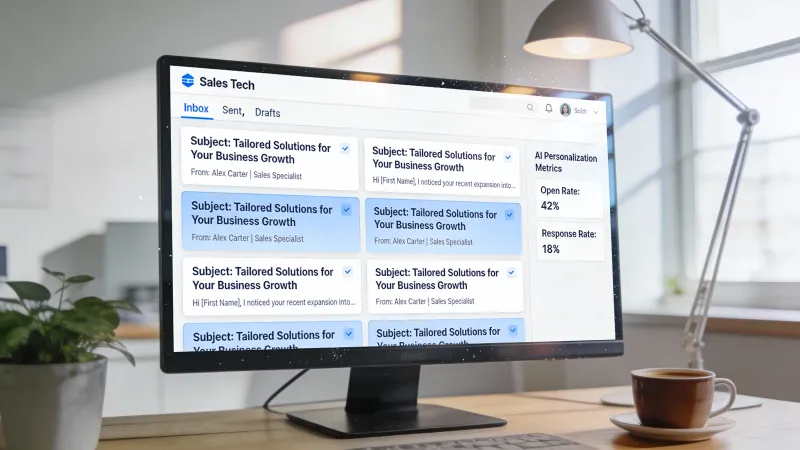
Cold email has a reputation problem. Inboxes overflow with generic pitches. AI makes it worse by helping people send more bad emails faster.
But AI can also do the opposite. It can help you send fewer emails that actually get responses.
The difference comes down to how you use it.
The Numbers Are Sobering
Most cold emails disappear into the void, and the people sending them never learn why because they never get feedback beyond silence.
The average cold email reply rate sits around 3.43%. That means roughly 97 out of 100 emails get ignored, deleted, or filtered to spam. Top performers hit 10% or higher, but they represent a small minority of senders.
What separates the 3% from the 10%? Not volume. Not cleverness. Relevance.
Personalized cold emails achieve 17% response rates versus 7% for generic templates, according to analysis of over 20 million emails. That 143% improvement comes from making recipients feel like you actually understand their situation rather than treating them as line items on a spreadsheet.
The Recipient Experience
Before diving into tactics, consider what happens on the other side of that send button.
One Hacker News user captured the current mood: “I feel like now with AI the cold outreach has gotten orders of magnitude worse.”
That frustration runs deep. People receive dozens of pitches daily. Most get five to seven seconds of attention before the delete key. When every email opens with “I noticed your company” or “Quick question,” recipients develop pattern recognition that filters out anything resembling a template.
Another commenter on that same thread put it bluntly: “nobody uses my first name in their subject line except people trying to sell me something.”
The bar for standing out keeps rising because AI raised the floor for everyone else.
What AI Actually Does Well
AI shines at research and drafting, not relationship building.
It can scan a company website, pull relevant news, analyze LinkedIn profiles, and synthesize that information into talking points faster than any human. What used to take 20 minutes of manual research now takes seconds.
Campaigns built on 4-7 email sequences achieve 27% response rates compared to 9% for shorter sequences. AI makes creating those varied follow-up messages economically viable. Writing five different angles for 200 prospects would crush a human. An LLM handles it without breaking a sweat.
The scale unlocks something important: you can afford to be selective. Instead of blasting 10,000 people with one message, you can target 500 with genuine personalization. Smaller lists with higher relevance beat massive lists with generic copy every time.
What AI Gets Wrong
Here’s where things fall apart.
Ekta Shewani, a freelance SEO outreach specialist, explained the limitation after extensive testing: “I have realized personalized email outreach is way better than using tools…Recently, I have increased personalized email outreach, and it helps me understand the domains better, analyze them better, and understand the people working there better.”
The insight matters. Writing emails manually forces you to think about recipients as individuals. AI removes that friction, which sounds good until you realize the friction was teaching you something.
Joe Fletcher, a marketing consultant, described a successful outreach that landed a meeting with a busy CRO: “it took a lot of research into this guy’s personal life, what his role in the business was.” The winning line referenced a weekend sports loss. No AI pulled that insight from a LinkedIn scrape.
Even well-designed AI tools stumble in predictable ways. Testing of Smartwriter.ai found it “completely misinterpreted a newsletter, confusing it with Substack and fabricating details like platform features that don’t exist.” Another tool, Outbound Flow, referenced non-existent content including “Christmas Story Leg Lamp” and “Turtle With the Golden Gun” in generated copy.
Hallucinations in cold email destroy credibility instantly. The recipient knows you never actually read their blog post because you cited an article they never wrote.
The Uncomfortable Truth About Automation
One Hacker News commenter posed an uncomfortable question about AI cold email tools: “All the attention in our field is on a technology that’s de facto being used as a force multiplier for stuff like sending spam.”
That comment landed hard because it captures something real. The same technology that enables thoughtful personalization also enables thoughtless volume. Most users choose volume.
This creates an arms race dynamic. As AI makes cold email easier, recipients develop stronger filters. As filters improve, senders need better personalization. As personalization improves, expectations rise. The equilibrium keeps shifting.
Making AI Work Without Losing Your Soul
The effective approach treats AI as research assistant, not author.
Start with list quality. Targeted cold emails can receive response rates of 15-25% while generic lists hover around 1-5%. AI cannot fix a bad list. It can help you find the right people, but you need to define what “right” means.
Use AI for discovery. Feed it a prospect’s website, recent press mentions, LinkedIn activity. Ask it to identify potential pain points, recent changes, or conversation hooks. The output gives you raw material. You decide what matters.
Draft with AI, but edit like a human. Generated copy needs tone adjustment roughly 90% of the time, based on industry experience. Read every email before it sends. Ask yourself: would I be annoyed receiving this? If the answer wavers toward yes, rewrite.
Keep emails short. Cold emails between 50-125 words receive the highest response rates. AI tends toward verbosity. Trim aggressively. Every word should earn its place.
The Follow-Up Question
Most responses come from follow-ups, not initial emails.
The first email introduces. Follow-ups build familiarity. By the third or fourth touch, recipients who might have ignored you initially start paying attention because persistence signals genuine interest.
But persistence has limits. Following up seven times signals desperation, not determination. Four to five emails in a sequence hits the sweet spot for most B2B outreach. After that, silence is an answer.
AI can draft follow-up variations quickly, but vary the angle, not just the wording. If your first email emphasized cost savings, the second might highlight implementation simplicity. Different value propositions catch different attention states.
Technical Setup Determines Half Your Success
None of this matters if your emails land in spam.
Custom domain setup with proper SPF and DKIM achieves 5.9% average reply rates while personal webmail gets only 1.2-2.1%. The technical foundation determines whether your carefully crafted message ever gets seen.
New domains need warming. That means sending small volumes to engaged recipients for several weeks before scaling up. Jumping straight to high volume with a fresh domain triggers spam filters immediately.
Keep sends reasonable. Around 25-40 emails per day per mailbox works for most setups. Trying to blast hundreds from a single address invites deliverability problems regardless of content quality.
When to Skip AI Entirely
Sometimes manual wins.
High-value prospects deserve individual attention that AI cannot replicate authentically. When you’re reaching out to a decision-maker who could change your quarter, invest the time to write something that couldn’t possibly be automated.
Small lists benefit from the learning that comes with manual research. Reading through 50 prospects’ LinkedIn profiles teaches you about the market in ways that scanning AI summaries never will.
Warm introductions beat cold outreach regardless of personalization quality. If you can find a mutual connection, a single introduction email outperforms an entire AI-optimized sequence.
The Ethical Line
AI enables scale. Scale enables abuse.
The difference between effective outreach and spam comes down to targeting. 74% of B2B buyers respond to relevant emails. Relevance means they might actually want what you offer. If your targeting is so broad that most recipients have no possible use for your product, you’re contributing to the inbox pollution everyone complains about.
Respect opt-outs immediately. Stop after reasonable attempts. Target people who could plausibly benefit. These aren’t just ethical guidelines. They protect your deliverability and reputation long-term.
Starting Small
The best approach: begin with what you can do well, then scale carefully.
Pick 50 prospects you understand deeply. Research each one manually, using AI only to accelerate gathering information. Write personalized emails where every line demonstrates specific knowledge. Send manually. Track responses.
Learn from what works before automating anything. The patterns you discover in those first 50 emails will shape how you use AI for the next 500.
The inbox remains hostile territory for anyone sending cold email. AI shifted the landscape by lowering barriers to personalization while simultaneously raising recipient expectations. The senders who thrive are those who use AI to genuinely understand prospects rather than to simply touch more people with less effort.
What would happen if you treated every cold email like a warm introduction you needed to earn?