
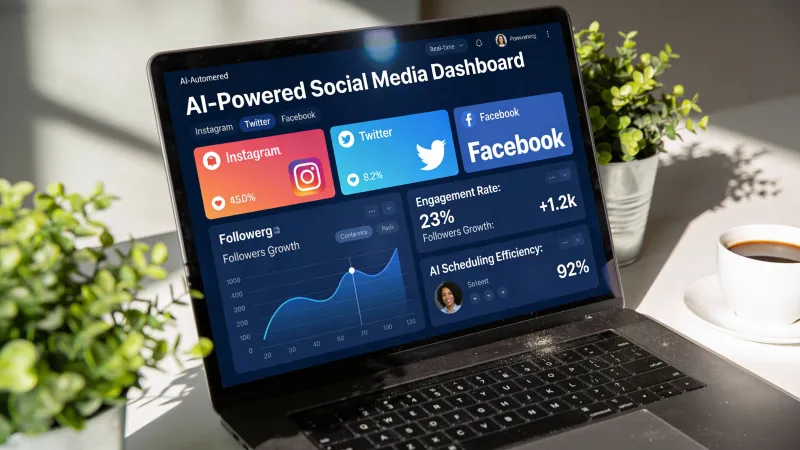
96% of social media professionals now use AI for social media tasks. Nearly three-quarters rely on it daily. The holdouts are a tiny minority.
But here’s what the adoption numbers don’t tell you: 45% of those users express caution about increased AI reliance due to quality concerns. Over 33% don’t even track how AI-generated content performs.
Everyone’s using it. Nobody’s sure it’s working. That’s where we are in 2025.
This is a practical guide to what AI actually does well for social media, where it consistently fails, and how to build automation that helps without making your brand sound like it hired a robot.
Where AI Earns Its Keep
Let’s start with what works. AI handles certain social media tasks genuinely well.
Brainstorming and Ideation
78% of social media professionals use AI for brainstorming post ideas. That’s the number one use case, and for good reason.
The blank page problem is real. You need five posts by Friday. You’ve written about your product seventeen ways. You’re out of angles. AI helps here because it’s seen millions of social posts and can suggest directions you haven’t considered.
This works because you’re not publishing AI’s ideas directly. You’re using them as starting points. AI suggests ten directions, you pick two worth developing, you write them in your voice. The ideation is fast; the execution is human.
Content Adaptation Across Platforms
A blog post needs to become a LinkedIn post, a Twitter thread, an Instagram caption, and a Facebook update. Same content, four different formats, four different audiences.
AI handles this translation quickly. It understands that LinkedIn wants professional framing, Twitter wants punchy sentences, Instagram wants casual engagement hooks. Firms using AI-driven content optimization tools reported a 25% reduction in content production time through this kind of adaptation.
The output usually needs editing. But starting with a platform-appropriate draft beats rewriting from scratch each time.
Caption Writing (With Review)
79% of creators report that AI enables them to produce more content faster, and caption drafting is a big part of that.
AI writes serviceable captions quickly. They’re grammatically correct, appropriately sized for each platform, and include reasonable hashtag suggestions. For routine posts, this alone saves real time.
The catch: AI captions tend toward the generic. They lack distinctive voice. They sound professional but not memorable. The time you save drafting, you need to spend editing for personality.
Still works out to a net time savings for most teams.
Scheduling and Timing Optimization
18.1% of organizations use AI specifically for cross-platform scheduling. The tools analyze when your specific audience is most active and schedule posts accordingly.
This is grunt work that AI handles better than humans. No social media manager wants to manually analyze posting times for every platform every week. AI does it automatically and updates as patterns shift.
The impact is modest but consistent. Better timing means slightly better reach, compounded across every post.
Performance Analytics and Reporting
AI excels at pattern recognition in data. Which posts performed? Why might that be? What topics drive engagement? What times work best?
Manual analysis of social metrics is tedious. AI surfaces insights faster and notices patterns humans miss. Marketers using AI for social media report efficiency gains of 12.2 hours per week, and analytics automation is a significant contributor.
The insight: AI is good at telling you what happened. It’s less good at telling you what to do about it. The interpretation and strategy still require human judgment.
The Results People Are Actually Seeing
Let’s look at documented outcomes.
Engagement Improvements
73% of businesses see engagement rate lifts from AI-assisted content. That’s a majority seeing positive results.
Some case studies show dramatic gains. One fashion brand reported a 285% jump in engagement. A Shopify store saw a 400% increase in content output.
These are outliers. But they suggest what’s possible with well-implemented AI workflows.
Efficiency Gains
The AI social media management market is expected to grow from $2.4 billion in 2024 to $8.1 billion by 2030. Companies aren’t investing at that scale without seeing returns.
What Coca-Cola Figured Out
Coca-Cola uses AI-powered tools to analyze customer preferences, engagement patterns, and activity times on social media platforms. They use this data to display targeted ads at optimal times, resulting in reduced ad spend and increased engagement.
The insight here isn’t revolutionary. Coca-Cola isn’t using AI to write posts. They’re using it to optimize when and where existing content appears. That’s a lower-risk, higher-certainty application.
Where AI Consistently Fails
Now for the parts that don’t make the marketing materials.
Authentic Voice
This is the big one. AI can mimic a general tone. It cannot replicate the specific quirks that make your brand sound like your brand.
As AI becomes more integrated into social media management, the common concern is whether using it might compromise authenticity. Authenticity is crucial for building trust, so striking the right balance between automation and human touch matters.
Overreliance on automation may make posts feel robotic and impersonal. This can erode trust with audiences, especially in communities that value transparency and personality.
The problem isn’t that AI writes badly. It writes competently. The problem is that competent but generic content disappears in feeds full of competent but generic content.
Real-Time Relevance
Social media moves fast. A trend emerges at 10am and is dead by 2pm. A news event happens and everyone’s posting about it.
AI isn’t built for this. Its training data is months or years old. It doesn’t know what happened yesterday. It can’t write the timely take that makes people share your post.
Real-time social media requires human judgment, speed, and cultural awareness that AI lacks.
Nuanced Community Management
A customer complains publicly. A troll starts a fight in comments. Someone asks a question that requires actual product knowledge. A PR situation develops.
AI shouldn’t handle these. The risk of a wrong response is too high. The need for judgment is too real.
AI chatbots in customer service fail at four times the rate of other AI tasks, per Qualtrics research. Social media interactions are less structured than customer service. The failure rate would likely be higher.
Original Creative Concepts
AI recombines patterns from its training data. It cannot have a genuinely new idea because genuine novelty requires creativity that emerges from lived experience.
AI is great for generating images, but not great for originality. AI tools shouldn’t be the sole solution. Everyone can tell it’s AI-generated.
For campaigns that depend on being distinctive, memorable, or surprising, AI assistance has limits.
The Over-Automation Trap
There’s a risk of over-automation. A 2025 IBM report on AI in customer service found that executives expect a 53% increase in AI-powered self-service use by 2027, but they also emphasize the need to maintain trust and satisfaction, not just volume.
The temptation is obvious. AI is faster and cheaper. Why not let it handle everything?
Here’s why: if you don’t know the difference between good and poor quality AI outputs, then AI is not the solution but a shortcut to poor quality results. The risk of relying too much on AI is that it makes your brand look cheap, like a brand that will cut corners.
Social media audiences are surprisingly good at detecting automation. They may not consciously think “this sounds like AI.” But they feel something off. Engagement drops. Trust erodes. The numbers look fine until suddenly they don’t.
The Accuracy Problem
AI models are only as good as the data they’re trained on. The time gap can occasionally result in AI tools offering recommendations based on outdated trends or user behavior. What’s even more problematic is that some AI tools can produce information that is not only inaccurate but perplexing.
This matters for social media because:
Facts get checked publicly. Post something wrong and someone will correct you in comments. That’s embarrassing at minimum, damaging at worst.
Trends move fast. AI suggesting you post about last month’s meme makes you look out of touch.
Platform rules change. AI might suggest strategies that worked six months ago but now get penalized by algorithms.
Every AI-generated post needs a human check for accuracy, relevance, and timeliness.
The Budget Reality
Despite 96% adoption, half of social media professionals rely exclusively on free AI tools. Nearly 67% have no plans to increase AI spending this year.
This tells us something important. The AI social media hype hasn’t translated into budget increases for most teams. People are using what’s available, not investing heavily.
That’s probably appropriate. The wins from AI social media management are incremental. Time savings. Slight engagement improvements. Better scheduling. These add up, but they don’t justify massive investments.
The sophisticated tools with advanced features might deliver more value. But for most teams, free or low-cost AI handles the basics well enough.
What a Balanced Approach Looks Like
Based on what works and what fails, here’s a framework.
Let AI Handle
Ideation and brainstorming. Generate angles, topics, content directions. Use AI’s breadth to escape your own rut.
First drafts. Get something on the page quickly. Accept that you’ll rewrite heavily.
Cross-platform adaptation. Translate content formats efficiently.
Scheduling optimization. Let AI figure out timing.
Performance analysis. Surface patterns in your data.
Repetitive administrative tasks. Tagging, categorizing, basic organization.
Keep Human
Final voice and polish. The edit that makes it sound like you.
Real-time and timely content. Anything responding to current events.
Community management. Complaints, questions, sensitive interactions.
Creative strategy. The big ideas and campaign concepts.
Brand decisions. What you stand for and how you express it.
Crisis response. Anything with PR implications.
The Workflow That Works
- AI generates options. Multiple ideas, drafts, or angles.
- Human selects and refines. Pick what’s promising, edit for voice.
- AI schedules and optimizes. Handle the logistics.
- Human monitors and responds. Stay engaged with the actual community.
- AI analyzes performance. Surface what worked.
- Human interprets and strategizes. Decide what to do differently.
This hybrid keeps AI’s efficiency while maintaining human judgment where it matters.
Measuring What Matters
Over 33% of social media professionals don’t track performance of AI-generated content. That’s a problem.
If you’re using AI, you should know whether it’s helping. Track:
Engagement rates on AI-assisted vs. human-written content. Is there a difference?
Time spent on content creation. Are you actually saving time?
Audience growth and retention. Is your community responding to the output?
Sentiment in comments. Are people engaging positively or just reacting?
Conversion metrics. Does social traffic from AI content convert as well?
Without measurement, you’re guessing. With measurement, you can optimize.
Platform-Specific Considerations
Different platforms reward different things.
LinkedIn tolerates more professional, somewhat formal content. AI writes LinkedIn-appropriate content fairly well. The audience expects polish over personality.
Twitter/X rewards speed, wit, and real-time relevance. AI struggles here. The platform’s value is in being current, opinionated, and distinctive.
Instagram is visual-first. AI can help with captions, but the images matter more. AI image generation is improving but often looks obviously AI-generated.
TikTok rewards authenticity and creative surprise. This is probably the worst platform for AI content. The algorithm favors genuine human personality.
Facebook has diverse content types and audiences. AI handles some (scheduling, basic posts) better than others (community management, group engagement).
Adjust your AI usage based on what each platform values.
The Market Direction
AI systems are estimated to take over whole campaign management on platforms such as Meta by 2026, controlling every aspect from images and videos to copy and audience targeting.
78% of marketers expect to automate more than 25% of their tasks with AI by 2026.
The direction is clear. AI involvement in social media will increase. The question is whether that involvement will be thoughtful or reflexive.
The teams getting this right treat AI as a tool with specific applications. They use it where it excels, compensate where it fails, and maintain human oversight throughout.
The teams getting this wrong treat AI as a magic automation button. They’ll produce more content faster, then wonder why engagement drops and audiences disengage.
Getting Started (Or Getting Better)
If you’re new to AI for social media:
Start with scheduling and ideation. These are low-risk, high-reward applications.
Try AI for first drafts, then rewrite heavily. Learn what AI gets right and wrong about your voice.
Track everything. Know whether AI is helping before you expand its role.
Don’t publish without review. Every AI output needs human eyes.
If you’re already using AI:
Audit your results. Is AI-generated content performing as well as human-written?
Check for voice drift. Does your feed still sound like you?
Review your workflow balance. Are humans still handling what matters?
Test reducing AI in some areas. Sometimes less automation is more.
The goal isn’t maximum AI usage. The goal is effective social media presence. AI is a tool toward that goal. It’s not the goal itself.
The Bottom Line
AI social media management works when applied thoughtfully. It fails when applied reflexively.
The documented wins are real: time savings, better scheduling, more content options, improved analytics. These compound over time.
The documented risks are also real: loss of authentic voice, over-automation, quality degradation, disconnection from audience.
The teams succeeding balance both. They use AI to handle the mechanical parts of social media while keeping humans on the creative, strategic, and community-facing parts.
Social media AI automation works best when it suggests, not dictates. That’s the principle. AI proposes, human disposes. AI generates, human refines. AI optimizes, human decides.
Follow that principle and you’ll get the efficiency without the robot voice.