
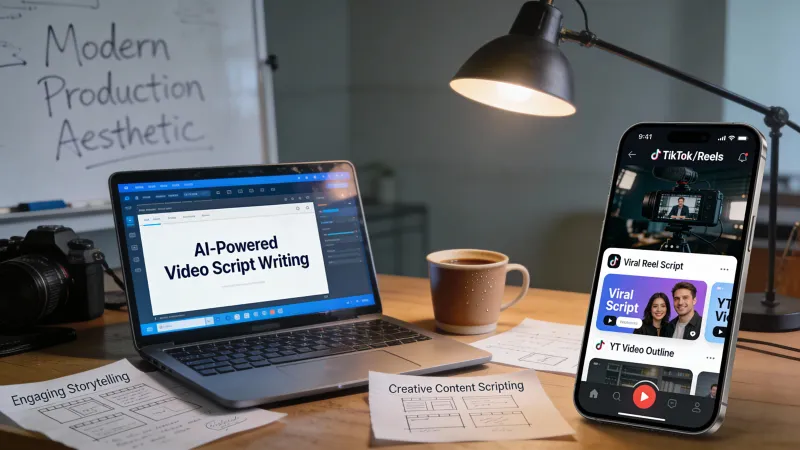
Video scripts are not blog posts read aloud. They require different pacing, different structure, and different words entirely. What reads well on a screen often sounds stilted when spoken, and what flows naturally in conversation can look unprofessional in print.
AI can help with this translation problem. But the generic approach produces generic results, and generic gets ignored. The trick is understanding what each platform actually rewards, then using AI to hit those targets faster than you could alone.
The Real Problem With AI Scripts
Most AI-generated video scripts fail in the same way: they’re technically fine, but they don’t sound like anyone. The pacing is off. The language is too polished.
This matters because video is personal. Viewers develop parasocial relationships with creators. They notice when something feels different. A Hacker News commenter described watching AI-generated content and “just thinking ‘oh that’s cool, looks alright’ but none of the…felt empty.” That emptiness is what you’re fighting against.
The solution isn’t avoiding AI. It’s using it differently. Instead of generating scripts and shipping them, you generate scripts and transform them. The AI handles structure and pacing. You add the parts that make it yours.
YouTube: The Watch Time Game
YouTube’s algorithm cares about one thing above all others: how long people keep watching. A video with 10,000 views and 80% completion will outperform a video with 100,000 views and 20% completion, according to recent platform analysis. Every second of your script needs to earn its place.
Structure That Earns Attention
The first 30 seconds determine everything. This is where most viewers decide to leave or stay. Yet most AI-generated openings start with some variation of “Hey everyone, today we’re going to talk about…” which is exactly what viewers have trained themselves to skip past.
Start with the promise instead. What will they know after watching that they don’t know now? What problem will be solved? The setup and context can come after you’ve given them a reason to care.
The middle sections need pattern interrupts every two to three minutes. Something visual shifts. The topic pivots. You ask a direct question. These breaks reset attention and push viewers past the natural drop-off points that tank your retention graphs.
Making AI Work for Long-Form
Generate outlines first, not full scripts. Tell the AI your topic, target length, and the key points you want to hit. Ask for a structural outline with timing estimates for each section. Review that outline before asking for any actual script text.
Then work section by section. A prompt like “Write the hook for this tutorial, keeping it under 30 seconds when spoken, using conversational second-person tone” will produce tighter results than “Write me a 10-minute YouTube script.”
After you have draft sections, add the B-roll notes. Where should you cut to screen recordings? When should graphics appear? AI can suggest these, but you’ll know better what you actually have footage for.
The crucial final step: read it out loud. Every sentence. If you stumble, that sentence needs rewriting. If it sounds like a textbook, cut it. If you’d never actually say those words to another human, they don’t belong in your script.
TikTok: Completion Rate or Death
TikTok operates on different physics. You have seconds to hook, limited time to deliver, and the algorithm ruthlessly punishes videos that viewers swipe past.
Video completion rates on TikTok reached 58.3% on average in 2026, but that average hides dramatic variation. Videos under 15 seconds hit 76.4% completion. Videos over 90 seconds? Just 22.7%. Length matters enormously here.
The completion threshold for virality has climbed too. You now need 70%+ completion rate to get significant algorithmic push, up from 50% in 2024. The bar keeps rising as more content floods the platform.
The Three-Second Test
Your hook exists for one purpose: stopping the scroll. If someone doesn’t pause within the first three seconds, nothing else in your script matters. They’ll never see it.
AI can generate hook options quickly. Ask for ten variations. Make them short, punchy, and specific to your content. “Give me 10 hook options for a TikTok about email marketing mistakes. Each hook should be under 3 seconds when spoken. Make them attention-grabbing without being clickbait.”
Then test which ones actually stop you when you scroll past them. The hook that works isn’t always the cleverest one. Sometimes it’s just the most direct.
Density Over Duration
Educational content achieves 67.2% completion rates on TikTok, outperforming most other categories. But educational doesn’t mean slow. It means information-dense. Every second delivers value or gets cut.
When using AI for short-form scripts, specify tight constraints. “Write a 30-second TikTok script about the biggest email automation mistake. Start with a hook. Deliver one insight. End with a payoff. No unnecessary words.”
After generating, ask the AI to cut it further. “Remove any words that don’t add value. Make it as dense as possible while staying clear.” This compression pass often improves short-form scripts dramatically.
Instagram Reels: Aesthetic Meets Information
Reels overlap with TikTok but skew slightly older and more polished. Production quality matters more here. The same hook that works on TikTok might feel too raw for Reels audiences.
Visual direction belongs in your script, not as an afterthought. Include notes about what viewers should see at each moment. Many Reels work with text overlays carrying the information while music or ambient sound provides atmosphere. Your script needs to account for this visual layer.
Sometimes your idea works better as a carousel than a video. When you’re explaining something step-by-step, static frames that viewers can swipe through at their own pace often outperform video where they’re forced to watch at your pace. AI can help you decide: describe your concept and ask whether video, carousel, or talking head would serve it best, along with reasoning.
One Idea Across Platforms
You don’t need separate ideas for each platform. One strong concept can become a YouTube deep-dive, a TikTok hook, and a Reels explainer. The script changes. The core insight stays.
Start with long-form. Write your YouTube script first because it forces you to think through the full argument. Then extract. Which single insight could stand alone as a 30-second TikTok? Which visual moment would work as a Reel?
AI handles this extraction well. Feed it your YouTube script and ask: “Identify 5 moments that would work as standalone TikToks. For each, write a new hook and adapt the content for 30-60 seconds.” The platform-specific adaptations follow naturally from there.
The Editing Reality
One HubSpot reviewer found that even the best AI script generators produce output that shouldn’t be used “exactly as is” without refinement. This matches what every experienced creator discovers: AI gets you to a first draft faster, but the first draft is not the final product.
The editing pass is where your voice emerges. Replace phrases you’d never actually say. Add the tangents that make it feel human. Cut the explanations that condescend to your audience. The AI doesn’t know your viewers. You do.
George Blackman, a scriptwriter who worked with creators like Ali Abdaal, described the scripting struggle as “spending hours staring at a blank page” and “struggling to find interesting ways to express ideas, writing sentences that didn’t sound right.” AI solves the blank page problem. It doesn’t solve the “sounds right” problem. That’s still your job.
Measuring What Actually Worked
After publishing, the metrics tell you what your script accomplished. Completion rate shows whether you held attention. Drop-off points reveal exactly where your script lost people. Comments indicate whether viewers connected. If you included a call to action, conversion shows whether they acted on it.
Feed these insights back into your next script. When something works, figure out why and replicate it. When viewers leave at a specific moment, study that section and understand what went wrong. AI can help analyze patterns across multiple videos if you give it your performance data.
Where This Goes Wrong
The biggest mistake is writing too much. A page of script equals roughly one minute of video. Writers consistently generate three pages for one-minute videos, then wonder why the pacing feels slow. After AI generates your draft, ask it to cut 30% without losing the core message. Then cut more yourself.
The second mistake is generic hooks. “Hey everyone, today we’re going to talk about…” is not a hook. It’s a warning that the creator couldn’t think of anything better. Always generate multiple hook options and pick the strongest one, even if it feels uncomfortable.
The third mistake is forgetting context. A YouTube audience clicking from search has different expectations than a TikTok audience scrolling the For You page. Specify this context in your prompts: “This video will appear in search results for people actively looking for this information” produces different scripts than “This video will interrupt someone mindlessly scrolling.”
The Workflow That Works
Pick one video idea. Decide on platform and length before you start.
State your core message in one sentence. If you can’t, your idea isn’t focused enough yet.
Generate a structure outline with AI. Review timing. Adjust sections.
Write the hook yourself or generate many options and pick the best. This matters too much to accept the first suggestion.
Generate body sections one at a time. Read each aloud. Rewrite what sounds wrong.
Add production notes. What should viewers see at each moment?
Cut aggressively. Then cut again.
The process gets faster with practice. The AI handles the heavy lifting. You provide direction and judgment. That combination produces scripts that actually work instead of scripts that technically exist.
What happens when you record a script that looked great on paper but falls flat on camera? That’s the gap between writing for reading and writing for speaking. AI can close some of that gap, but only if you use it to generate options rather than accept its first answer. The best scripts often come from the fourth or fifth revision, not the initial output.
For more on turning one piece of content into multiple formats, see our guide to AI Content Repurposing.