
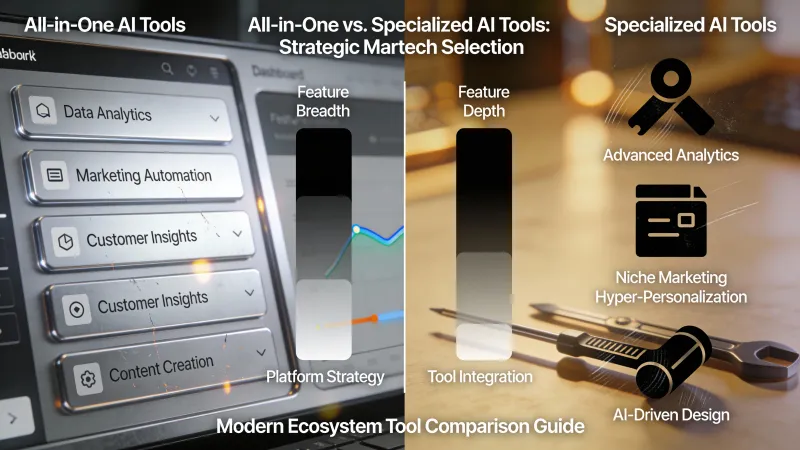
The debate starts simple. One tool or many? Then it gets complicated.
You have ChatGPT handling your emails, summarizing documents, writing code, generating images, and researching competitors, all in the same conversation window. Or you have Perplexity for research, Claude for writing, GitHub Copilot for code, and Midjourney for images, each running in separate tabs, separate subscriptions, separate workflows that you somehow need to keep synchronized.
Both approaches work. Neither is obviously correct. And the people most invested in AI tools cannot seem to agree on which path leads somewhere useful.
The Case for Generalists
ChatGPT sits at 200 million weekly users. Claude crossed 100 million. These numbers did not happen because people wanted complexity.
General-purpose AI tools win on friction. You open one application. You ask your question. You get an answer. No context switching. No wondering which specialized tool handles this particular task. No managing seven different subscriptions for seven different capabilities.
The generalist advantage shows up clearest in unpredictable workflows. Creative brainstorming sessions where you start with market research, pivot to copywriting, then suddenly need help debugging a spreadsheet formula. A specialist stack would require three tool switches in fifteen minutes. A generalist handles the entire session without breaking your concentration.
There is also the data consolidation argument. When one tool sees all your interactions, it builds context. It remembers your preferences, your writing style, your recurring projects. Specialized tools each start from zero. They know nothing about each other. Your research tool cannot inform your writing tool, not without manual copy-pasting that defeats the purpose of automation.
And then cost. One ChatGPT Plus subscription runs $20 monthly. A serious specialist stack might include Perplexity Pro ($20), Claude Pro ($20), Jasper ($40+), and Midjourney ($10+), easily exceeding $100 monthly for capabilities that substantially overlap.
When Specialists Win
Here is the uncomfortable truth about general models: they spread their capabilities thin, trading depth in any single domain for breadth across many.
On Hacker News, a user named nuz identified the core constraint during a discussion about whether generalist foundation models can beat specialized tuning: “With an equal amount of compute, specialized models will win… generalized ones have to spread out their weights to do a ton of irrelevant things.” The math works against generalists. Every capability a general model adds dilutes its performance on everything else.
This shows up in real workflows. Legal professionals using Harvey instead of ChatGPT get cited legal references and auditable sources rather than plausible-sounding text that might be hallucinated. Financial analysts using Rogo access real-time market data and proprietary research that general LLMs simply do not have. The specialized tool is not marginally better. It is categorically different.
Content creator Timo Mason tested both approaches for his actual workflow, running what he called a “Gordon Ramsay test” comparing Claude and ChatGPT for content creation. His conclusion was direct: “Stop being loyal to tools. Be loyal to results.”
He now runs a split workflow. “Claude handles all my long-form content” while “ChatGPT handles all my short-form content.” Neither tool works for everything. “Each AI has its lane, and forcing them outside of it is a waste of time.”
The pattern holds across domains. Developers report Claude producing cleaner code with better architecture decisions. Researchers find Perplexity’s source citations essential for credible work. Writers discover that Jasper’s marketing frameworks generate copy faster than prompting a general model.
Specialization also matters for data access. A general LLM trained on public internet data cannot see your company’s internal documents, your industry’s proprietary databases, or real-time information published after its training cutoff. Specialized tools built around specific domains often include these integrations. The capability gap is not about model intelligence. It is about information access.
The Integration Problem
Here is where the debate gets messy.
Specialized tools work better at their specific tasks. But nobody’s workflow consists of one task repeated endlessly. Real work involves research flowing into analysis flowing into writing flowing into editing flowing into distribution. Each handoff between specialized tools introduces friction, potential error, and lost context.
One XDA Developers writer articulated the specialist philosophy for local LLMs: “With so many options out there, each specializing in its own field, why just limit yourself to a single ‘all-rounder’ instead of multiple focused models.” The logic seems obvious. Use the best tool for each job.
But “best” assumes you can cleanly separate jobs. Real creative work resists that separation. You discover something during research that changes your writing angle. You notice a pattern while writing that sends you back to research. The feedback loops between tasks matter as much as the tasks themselves.
The integration question also involves data privacy and consistency. Using five specialized tools means your data lives in five places, subject to five privacy policies, five security implementations, five potential breach points. A single generalist tool concentrates risk but simplifies compliance.
And then there is the cognitive load of tool selection itself. Before you can work, you must decide which tool handles this task. That decision requires maintaining mental models of multiple tools’ capabilities and limitations. The overhead is not zero. For some people, it is significant enough to negate the specialist advantages.
What the Users Actually Do
The most interesting pattern in real AI adoption is not the choice between generalist and specialist. It is the evolution of that choice over time.
New users almost always start with generalists. ChatGPT’s free tier removes barriers. The interface is simple. One tool, one place to learn. This is rational. You cannot know what specialized tools you need until you understand what tasks AI actually helps with.
Intermediate users often swing hard toward specialists. They discover ChatGPT’s limitations in their specific domain. They read about specialized alternatives. They build elaborate multi-tool workflows, each application handling its designated function.
Advanced users frequently simplify again. Not back to one tool, but to fewer tools used more intentionally. They keep a generalist for unpredictable tasks and one or two specialists for their highest-volume workflows. The rest gets cut. The complexity was not worth the marginal capability gains.
The Hacker News user theossuary captured this lifecycle from a technical perspective in that same discussion thread: “Having built specialized models for years, the cost of having a data science team clean the data and build a model is pretty high… For much more general things… I think multi-modal models are going to take over.” Specialization has costs. Those costs only make sense when the task volume justifies them.
The Questions That Actually Matter
The generalist-versus-specialist framing assumes a stable answer exists. It probably does not.
The right approach depends on questions most articles skip over: How predictable is your workflow? If you know exactly what tasks you need AI for, specialists make sense. If your work involves constant pivoting between task types, generalists reduce friction.
How much does depth matter? Surface-level assistance across many domains differs from expert-level assistance in one domain. A content marketer writing blog posts has different requirements than a securities lawyer reviewing contracts. The acceptable error rate varies by orders of magnitude.
What is your tolerance for tool management? Some people genuinely enjoy optimizing their tech stacks, testing new applications, integrating specialized solutions. Others experience that overhead as pure cost. Neither preference is wrong. They are just different constraints on the same optimization problem.
How fast is your domain changing? AI capabilities evolve monthly. A specialized tool built around 2024 model limitations might become obsolete when 2026 generalists close the capability gap. Investing heavily in specialist infrastructure carries technology timing risk that generalist reliance does not.
Where This Leaves Us
The debate between all-in-one and specialized AI tools mirrors an older argument about software in general. Should you use an integrated suite or best-of-breed applications? That question has been debated for decades without resolution because the answer genuinely depends on context.
But here is what makes the AI version different: the tools themselves are changing faster than anyone can evaluate them. By the time you have thoroughly tested a specialized workflow, the generalist models may have caught up. By the time you have committed to a generalist, new specialists may have opened capability gaps worth the switching cost.
Timo Mason’s advice echoes in this uncertainty: “Stop being loyal to tools. Be loyal to results.” The attachment should be to outcomes, not platforms. The willingness to switch should be high. The sunk cost of learning one tool should not trap you in using it for tasks it handles poorly.
The people who seem happiest with their AI workflows are not the ones who found the right answer. They are the ones who stopped looking for a permanent answer and started treating tool selection as an ongoing experiment, something to revisit every few months as both their needs and the tools evolve.
Maybe that is the only honest conclusion. The question of one tool versus many does not have a solution. It has a practice: paying attention to what actually works, being willing to change when it stops working, and accepting that the landscape shifts faster than any static strategy can accommodate.
The tools will keep improving. The debate will keep continuing. And somewhere in between, actual work will get done by people who cared less about having the right answer than about having an answer that worked well enough for now.