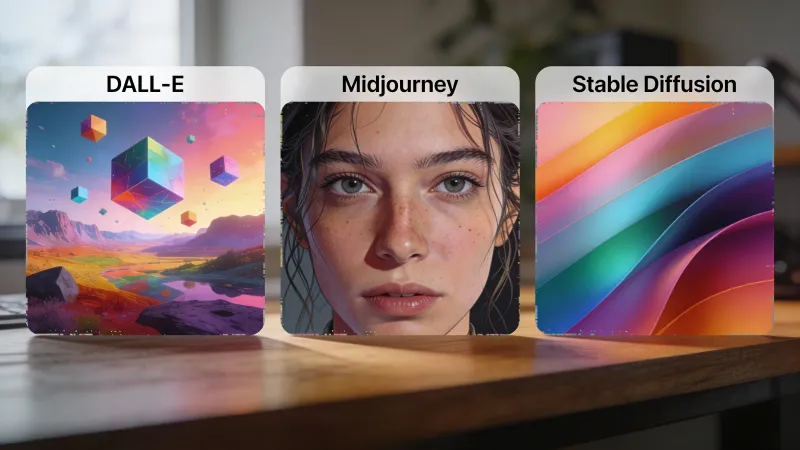
The market split happened fast. In 2022, DALL-E was the only serious option for AI-generated images, and you needed waitlist access to try it. Three years later, the landscape looks completely different, with Midjourney commanding the artistic high ground, DALL-E pivoting to conversational workflows, and Stable Diffusion building an open-source empire that rivals both.
Each tool attracts a different kind of user. Midjourney pulls in artists who want images that feel crafted. DALL-E appeals to people who prefer typing instructions in plain English and watching ideas materialize. Stable Diffusion draws the builders, the tinkerers, the people who want to understand how the machine actually works.
What you pick depends on what you value.
The Philosophical Divide
Closed platforms versus open models. This is the fundamental tension underlying every comparison.
DALL-E and Midjourney are walled gardens. You send prompts to their servers, their models generate images, and you download the results. The models themselves remain proprietary, inaccessible, unchangeable. You are renting capability.
Stable Diffusion flips this entirely. Download the model. Run it on your own hardware. Modify it however you want. Train it on your own data. No subscription fees, no content policies beyond what you impose on yourself, no dependence on someone else’s servers staying online.
As one Hacker News commenter put it bluntly: “Stability AI with Stable Diffusion is already at the finish line in this race, by being $0, open source.”
But free is not the same as easy. That is where things get complicated.
Midjourney: When Aesthetic Quality Trumps Everything
Midjourney has consistently produced the most visually striking images of any generator. The images look like they were made by someone with taste, not just technical ability. Lighting feels considered rather than calculated. Compositions seem intentional. Details emerge that you did not explicitly request but that make the image better.
This matters enormously for certain use cases. Brand imagery needs to evoke feeling, not just depict objects accurately. Concept art must inspire, not just illustrate. Marketing visuals compete for attention against professionally designed alternatives, and Midjourney outputs can hold their own in that competition.
One user on Hacker News expressed this clearly: “I use comfyUI/SD and MJ and I have never seen anything on the level of what I get out of MJ. MJ routinely blows my mind though and it is very rare something from SD does.”
The downside is access. Midjourney operates through Discord, which is either fine or deeply annoying depending on your relationship with that platform. The web interface launched in 2025 helps, but the Discord-first design remains. No free tier exists anymore. You pay before you generate.
Text rendering has improved but still trails DALL-E by a wide margin. Signs, logos, and typography remain unreliable. If your image needs words, Midjourney will disappoint you more often than not.
Pricing reality:
- Basic plan: $10/month for 200 generations
- Standard plan: $30/month for 15 hours of generation time
- Pro plan: $60/month for 30 hours plus stealth mode
The hours-based pricing on higher tiers can be confusing. One complex image with multiple refinements might consume more time than ten simple generations. Budget accordingly.
DALL-E: The Conversational Approach
DALL-E 3 through ChatGPT represents a fundamentally different workflow. You describe what you want in natural language. The system interprets your intent, often expanding sparse prompts into detailed specifications before generating. You refine through conversation rather than prompt engineering.
This accessibility is genuine and valuable. The learning curve that exists with Midjourney and Stable Diffusion largely disappears. You talk to it like you would talk to a human designer, and it mostly understands what you mean.
Text rendering is where DALL-E genuinely excels. Neon signs that actually spell correctly. Book covers with legible titles. Product mockups with accurate labels. For any image requiring integrated typography, DALL-E is the default choice because everything else fails too often.
The integrated ChatGPT workflow matters more than it might seem. Generate an image, then ask for variations. Request specific changes through conversation rather than rewriting your entire prompt. This iterative refinement feels natural in a way that other platforms have not matched.
But the aesthetic gap is real. DALL-E images look competent rather than inspired. Clean rather than evocative. Professional rather than artistic. For stock-photo replacements and functional graphics, this is fine. For hero imagery meant to stop someone mid-scroll, the results often feel generic.
The content policies are also more restrictive than competitors. Certain artistic styles, historical figures, and concepts that other platforms handle without issue will be declined. Whether this matters depends on your use case, but it is worth knowing the limitations exist.
Pricing reality:
- ChatGPT Plus subscription: $20/month for unlimited generations through the interface
- API access: Variable by resolution, check current rates
- Commercial rights included on all paid plans
Stable Diffusion: Freedom Has a Learning Curve
Stable Diffusion is not a product. It is a foundation that thousands of products build on. The base models are open source. Anyone can download them, modify them, or train entirely new models using the same architecture.
This creates an ecosystem rather than a single tool. ComfyUI for node-based workflows. Automatic1111 for a traditional interface. Hundreds of specialized checkpoints trained on specific aesthetics. LoRAs that add capabilities or styles without retraining entire models. ControlNet for precise compositional guidance.
The possibilities are genuinely unlimited, but so is the complexity.
A Hacker News user captured the trade-off precisely: “generating thousands of SD images locally and selecting the best often yields superior results compared to paying for individual DALL-E attempts.” The ceiling is high. The floor requires serious investment to reach.
For organizations with technical capacity, the advantages are substantial. Fine-tune on your brand’s visual language. Generate at scale without per-image costs. Keep everything on your own infrastructure with no data leaving your control. Build custom pipelines that integrate image generation into existing workflows.
For individuals or teams without engineering support, the complexity can be prohibitive. Installation alone involves Python environments, GPU drivers, VRAM management, and model configuration. Each new capability adds another layer to understand.
Pricing reality:
- Self-hosted: Free (hardware costs only, need 8GB+ VRAM minimum)
- Cloud providers (RunPod, Replicate): $0.002-0.01 per image
- Consumer GPU for local use: $500-1,600 depending on capability
Flux: The New Contender
Black Forest Labs released Flux in 2024, and it quickly established itself as a serious player. The team includes former Stable Diffusion researchers, and it shows.
Photorealism is the primary strength. Human faces render without the uncanny artifacts that plague other models. Hands have the correct number of fingers more consistently. Skin texture and lighting behave like they would in actual photography.
Speed is also notable. Flux Schnell generates in roughly 20 seconds per image, faster than Midjourney and dramatically faster than SDXL without quality sacrifices that usually accompany acceleration.
The trade-off is artistic range. Flux excels at photorealistic rendering but produces less interesting results for stylized, illustrative, or fantastical content. If you need product photography or lifestyle imagery, Flux competes with or exceeds Midjourney. If you need concept art or imaginative compositions, Midjourney maintains the lead.
Pricing reality:
- Free tier available on Flux Pro with daily limits
- Beyond limits: $1 for 33 images (Pro) or 333 images (Schnell)
- Open weights available for self-hosting
Adobe Firefly: The Safe Choice
Firefly matters primarily for one reason: training data provenance. Adobe explicitly trains on licensed and public domain content, making the results safer for commercial use from a copyright perspective.
The quality is respectable without being exceptional. Integration with Photoshop and the broader Creative Cloud ecosystem is the real value proposition. Generative Fill for removing or adding elements to existing images works remarkably well.
For organizations concerned about intellectual property liability, Firefly provides peace of mind that other tools cannot match. Whether that concern is justified given current legal uncertainty is debatable, but risk-averse enterprises have legitimate reasons to prioritize this.
Pricing reality:
- Included with Creative Cloud subscriptions
- Standalone plan: $10/month for unlimited generations
- Enterprise plans with additional indemnification available
The Real-World Decision Matrix
Most comparisons organize by feature. Let me organize by situation instead.
You are a solo marketer who needs visuals daily.
DALL-E through ChatGPT Plus. You already pay for the subscription. The conversational interface requires no learning curve. Text rendering works when you need it. Quality is good enough for social posts, blog headers, and presentation slides.
You run a creative agency producing premium brand work.
Midjourney Pro. The aesthetic quality justifies higher costs for client deliverables. Learn the prompt language properly because the investment pays off quickly. Budget additional time or tools for anything requiring text.
You have engineering resources and high-volume needs.
Stable Diffusion through a managed pipeline. The per-image economics dominate at scale. Fine-tuning on brand assets produces consistency impossible elsewhere. Initial setup cost amortizes across thousands of generations.
You need photorealistic product imagery specifically.
Flux Pro. The realism for commercial photography use cases exceeds other options currently. The pricing model works well for project-based needs rather than ongoing subscriptions.
Your legal team is risk-averse about AI-generated content.
Adobe Firefly. The training data provenance and Adobe’s commercial reputation provide defensibility that matters in regulated industries or conservative corporate environments.
What the Practitioners Say
Online discussions reveal patterns that feature comparisons miss.
The stagnation critique appears repeatedly. One user noted: “DALL-E was the first but, in my experience, the lower-quality option.” Another observed that development seemed to stall: “DALL-E 2, where it did not just stagnate for over a year…but actually seemed to get worse.”
OpenAI has since addressed some of these concerns with DALL-E 3, but the perception lingers among power users who remember the earlier gap.
Midjourney maintains passionate defenders. The quality difference is not subtle for artistic work. But the Discord interface genuinely frustrates people accustomed to traditional applications.
Stable Diffusion discussions tend toward technical depth. Which checkpoint for which style. ControlNet configurations for specific compositional needs. The community produces more tutorials and guides than any commercial platform because users must help each other navigate the complexity.
The Uncomfortable Truth About Quality
Output quality is not a single dimension. It fragments into several distinct aspects that different tools handle differently.
Prompt adherence: Does the image contain what you asked for? DALL-E leads here, particularly for complex multi-element requests.
Aesthetic polish: Does the image look professionally finished? Midjourney leads here, consistently producing outputs that feel designed rather than generated.
Photorealism: Does the image look like a photograph? Flux leads here for human subjects and product imagery.
Technical flexibility: Can you control specific aspects precisely? Stable Diffusion leads here through ControlNet, inpainting, and other advanced features.
Text rendering: Can you include readable typography? DALL-E leads here by a substantial margin.
No tool wins across all dimensions. The best choice depends on which dimensions matter for your specific work.
The Multi-Tool Reality
Professional teams rarely commit to a single platform. The typical stack includes two or three tools, each handling specific use cases.
DALL-E for anything requiring text. Midjourney for hero images and aspirational content. Stable Diffusion or Flux for high-volume generation or specialized fine-tuning.
This sounds like added complexity, but it actually simplifies decisions. Stop asking which tool is best and start asking which tool fits this specific task.
The monthly cost of maintaining access to multiple platforms is typically less than what a single stock photo subscription cost three years ago. The capability difference is incomparable.
Looking Forward
The market continues to fragment rather than consolidate. New models appear regularly. Existing platforms iterate constantly. The best tool in January may not be the best tool in June.
This suggests a pragmatic approach: Pick something accessible that handles your most common needs. Learn it well enough to be productive. Stay loosely aware of alternatives without chasing every new release. Switch when a clear improvement emerges, not when marketing promises one.
The technology improves faster than most users can absorb. A tool that felt limited last year might now exceed what you need. Revisit your assumptions periodically.
What remains constant is that these tools amplify creative direction rather than replace it. Someone with clear visual intent and weak prompt skills will outperform someone with sophisticated prompt engineering and no artistic vision.
The image generators create what you describe. Describing something worth creating remains your job.