
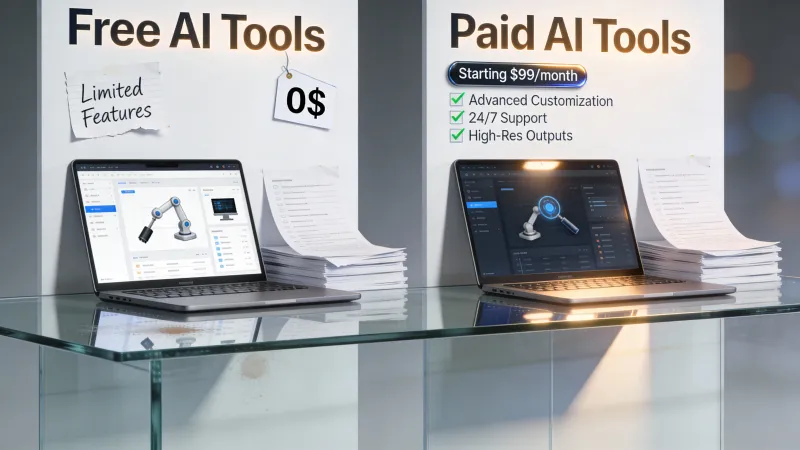
The free tier is generous. Until it isn’t.
You’re drafting something important when the message limit hits, and suddenly the AI suggests you wait five hours or pay twenty dollars a month to keep going, which feels like extortion when you’re mid-thought on a deadline that doesn’t care about usage windows.
This isn’t theoretical. It happens constantly. The question isn’t whether free AI tools work. They do. The question is whether they work when you need them to work, and that distinction matters more than any feature comparison chart.
What Free Actually Gives You
Free tiers have become surprisingly capable over the past two years as companies compete for users who might eventually convert to paying customers, which means you can accomplish real work without spending anything.
ChatGPT Free gives you access to GPT-4o, which would have been state-of-the-art just eighteen months ago. You get 10 messages every five hours using the full model, then automatic downgrade to GPT-4o mini. File uploads work. Web browsing works. DALL-E generates 2-3 images per day.
Claude Free offers approximately 25-30 messages daily, all using Claude Sonnet 4, with a sliding usage window that resets roughly every five hours. The 100,000-token context window remains identical to the paid tier. File uploads function the same way.
Gemini Free through Google AI Studio provides generous rate limits with access to current models, though the web interface feels less polished than competitors.
The patterns are similar. You get the real thing, just rationed.
What you don’t get: consistent access during peak hours, priority processing, longer conversations without interruption, and the premium models that handle complex reasoning tasks better.
The Paid Tier Reality
Twenty dollars per month is the standard price. ChatGPT Plus, Claude Pro, Gemini Advanced all converge on this number. It’s become the default expectation for AI access, a kind of baseline subscription that companies assume knowledge workers will absorb.
ChatGPT Plus increases your limit to 160 messages every three hours with GPT-5 and provides 50 DALL-E images in the same window. Claude Pro delivers approximately five to ten times the daily message allowance, with many users exceeding 100 messages without interruption.
The real difference isn’t the raw numbers. It’s the removal of friction.
On Hacker News, user replwoacause put it simply: “I feel like I hit my limit a bit sooner than I would have liked.” That’s the free tier experience condensed into one sentence. The paid tier makes that feeling disappear, at least until you’re doing something unusual.
User satvikpendem shared a common experience: “I stopped my ChatGPT subscription and subscribed instead to Claude, it’s simply much better.” That comment captures something important about the paid tier landscape. People move between services. The twenty dollars doesn’t lock you into anything permanent.
When Free Is Enough
Free works fine for exploration. You’re learning what AI can do. You’re testing prompts. You’re figuring out which service matches your thinking style. Burning through paid access while you’re still experimenting wastes money.
Free works for occasional tasks. One-off research questions. Quick drafts you’ll heavily edit anyway. Brainstorming sessions where the ideas matter more than the polish.
Free works when speed doesn’t matter. If you can wait five hours for your limit to reset, you effectively have unlimited access distributed across time rather than concentrated when you need it.
And free works better than most people realize. User ddxv on Hacker News observed: “I think most people on the $200 tiers could get 90% of what they want from a cheaper tier.” That applies even more strongly to the free-versus-paid divide.
The free tier handles:
- Research and information synthesis
- First drafts of standard documents
- Code explanation and debugging
- Learning conversations with no deadline pressure
- Creative brainstorming without production requirements
Millions of people use AI this way. They accomplish useful work. The limitations shape their workflow rather than blocking it.
When to Upgrade
The decision point arrives when friction becomes friction you can measure in dollars.
Calculate it directly. How many times per week does the limit interrupt you? What does that interruption cost in lost momentum, delayed work, or forced context switches? If those costs exceed twenty dollars monthly, the math is simple.
Upgrade when you’re building workflows. If AI becomes part of how you work rather than something you occasionally consult, the free tier’s unpredictability undermines the whole point. Workflows need reliability.
Upgrade when you’re using AI professionally. Client work, business operations, anything where “the AI ran out of messages” isn’t an acceptable explanation for delays. Professional use demands professional access.
Upgrade when context matters. Long documents, extended conversations, complex reasoning chains. Free tiers often truncate or degrade exactly when the task gets sophisticated, precisely when you need full capability.
User dtagames on Hacker News captures the professional perspective: “This is why folks making software products that sell or are expected to sell are willing to pay the monthly fee.” The subscription cost becomes negligible against the value of reliable output.
Another telling comment from ToDougie on Hacker News described Claude Pro as “spectacular about 98% of the time” for business planning, content generation, research, and brainstorming. That 98% reliability rate is what you’re actually buying.
The Middle Ground Nobody Talks About
Between free and paid exists a strategy most people miss.
Use free tiers strategically. Spread your usage across multiple services. ChatGPT’s limits reset independently of Claude’s limits. Gemini operates on its own schedule. Combined, three free tiers provide more daily capacity than any single paid subscription.
Switch contexts by task. Use Claude’s free tier for writing when you know you’ll only need a few exchanges. Use ChatGPT’s free tier for image generation. Use Gemini for research where Google’s data freshness matters.
Keep one paid subscription. Pick the service that handles your most critical tasks and pay for reliability there. Use free tiers everywhere else. Most people don’t need unlimited everything.
This approach works better than it sounds. The friction of switching services is real but manageable. The cost savings are also real.
The Enterprise Question
At $200 per month, ChatGPT Pro promises unlimited access across all models including GPT-5 Pro. Claude’s equivalent tier operates similarly. These exist for people whose usage genuinely requires unlimited capacity.
But user jqpabc123 on Hacker News raised a skeptical point: “You’re looking at $100-250/month minimum” and characterized the current landscape as offering “unreliable answers at high cost.”
That skepticism has merit. Even enterprise tiers enforce undefined “fair use” policies rather than truly unlimited access. The word “unlimited” does work that the reality doesn’t fully support.
Most individual users don’t need the $200 tier. Power users who genuinely push limits typically justify the cost through measurable productivity gains. If you’re not sure whether you need it, you probably don’t.
What the Comparison Charts Miss
Every article comparing free and paid tiers includes a table. Features in columns. Checkmarks and X marks. Message limits. Context windows. Model access.
These tables tell you almost nothing useful.
The tables can’t capture the experience of hitting a limit mid-task. They can’t quantify the cognitive cost of switching to a backup service because your primary ran out. They can’t measure the relief of knowing you won’t be interrupted during focused work.
Free and paid aren’t different products. They’re different relationships with the same product.
Free treats you like a visitor. The limits remind you constantly that you’re on borrowed time, that the full experience exists behind a payment wall, that your access is provisional and could end any moment.
Paid treats you like a customer. The limits exist but rarely surface. You work without the background awareness that interruption might arrive. That psychological shift matters more than any feature delta.
What Actually Matters
The free-versus-paid question misses something fundamental about how AI tools function in practice, something that becomes obvious only after months of daily use with both tiers.
The model matters less than the conversation.
A mediocre prompt to a premium model produces worse results than a refined prompt to a free model. The skill you develop in communicating with AI transfers across tiers and services. Someone who understands how to structure requests, provide context, and iterate productively will outperform someone with unlimited access who treats AI like a search engine.
Free tiers force you to be economical. That constraint develops skills. Paid tiers remove the constraint. That convenience can mask poor technique.
Neither approach is wrong. But the person who learned on free and upgraded to paid brings something the person who started with unlimited access never had to develop.
The Honest Answer
Pay when it saves you money. Stay free when it doesn’t.
Twenty dollars a month is nothing if AI genuinely improves your work. It’s pure waste if you’re paying for access you don’t use or paying to avoid friction you could eliminate with better planning.
The AI companies want you to pay. Their free tiers exist to demonstrate value, not to serve your needs indefinitely. Understanding this dynamic doesn’t make you cynical. It makes you realistic.
Try free first. Really try it. Hit the limits. Feel the friction. Then decide whether that friction costs more than twenty dollars a month.
For most people, the answer is no. For some people, the answer is obviously yes. The question is which category contains you, and only you can answer that through actual use rather than theoretical comparison.
The free tier isn’t lesser AI. It’s the same AI with a meter running. Whether that meter matters depends entirely on how you work, when you work, and what happens when the meter hits zero at the wrong moment.