
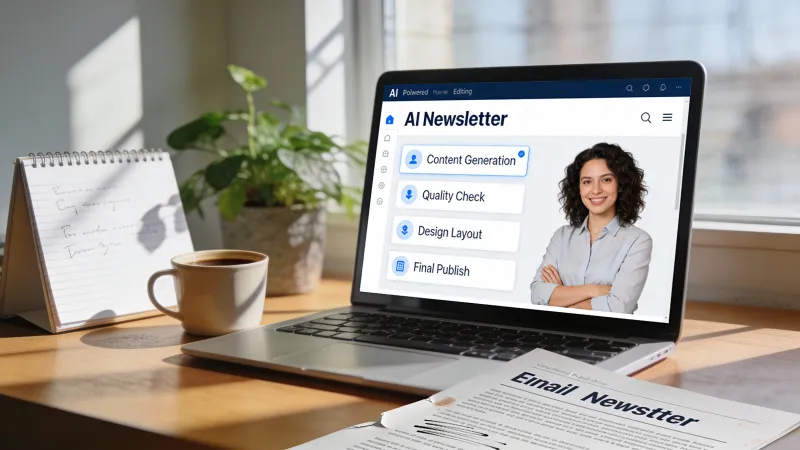
Issue one is exciting. Issue 52 is where newsletters go to die.
The math is brutal, and most people don’t do it before starting. A weekly newsletter means 52 editions per year. Each edition needs three to five solid content pieces. That’s somewhere between 150 and 260 individual pieces of content annually, not counting the curation, the editing, the formatting, the subject line testing, and the distribution.
One creator on Indie Hackers put it bluntly: “All in, takes about 6-8 hours, including writing, designing and pondering what to say.” Another responded with “About 4hrs a day Mon-Fri and an hour on Sunday. So 21hrs depending on the complexity of my essays.”
That’s a part-time job. Sometimes a full-time one.
AI can compress those hours. But using it well requires understanding what it’s actually good at, where it falls apart, and how to build a system that produces content worth reading week after week.
Where AI Actually Helps
Not everything in newsletter production benefits equally from AI. Some tasks get dramatically faster. Others barely improve at all.
Summarization and curation. Most newsletters aggregate content from elsewhere, then present it with commentary. AI handles the summarization part well. Feed it an article, get back the key points in two sentences. Do that ten times and you’ve got a link roundup in minutes instead of an hour.
First drafts. Starting from blank is painful. AI gives you something on the page. Even if you rewrite most of it, having clay to shape beats staring at nothing. The transformation from zero to something is where AI provides the most dramatic time savings.
Recurring sections. Weekly tips, industry updates, quote roundups. Once you establish the format, AI can generate these reliably. Same structure, fresh content each time.
Content transformation. Turning a blog post into newsletter highlights. Converting webinar notes into takeaways. Distilling long reports into digestible summaries. These transformations happen quickly with AI handling the grunt work.
Where AI Fails
The things that make newsletters worth subscribing to are exactly the things AI struggles with.
Original perspective. A newsletter that only summarizes what others said is a worse version of an RSS feed. Readers want your take. Why does this matter? What’s everyone getting wrong? What do you see that others miss? AI can present information but it can’t generate novel insight about your specific industry from your specific vantage point.
As one Hacker News commenter noted about AI content: “If you code up a simple LLM wrapper, it will suck, because it will just hallucinate.” Finding the right balance means knowing where human judgment is non-negotiable.
Authentic voice. Generic AI output makes your newsletter sound like everyone else’s. The personality that makes readers feel like they’re hearing from a specific person requires actual personal input. AI can mimic sentence patterns but it can’t replicate lived experience.
Editorial judgment. Deciding what matters this week, what angle to take, what’s been covered too much already. These choices define the difference between a newsletter people anticipate and one they eventually ignore.
The Real Time Savings
The newsletter creator who shared their workflow at The Digital Creator described going “from spending 6-8 hours per newsletter to 2 hours…while my content got better, not worse.” That’s a significant compression, but note the qualifier. Better content, not just faster content.
The trap is treating AI as a replacement rather than an accelerant. Use it to clear the runway so you can focus on the parts that only you can do. Skip that step and you’ll produce forgettable content faster, which isn’t actually an improvement.
Another creator noted the core problem with pure AI generation: “the writing sounds… off. Generic. Like it could be from anyone.” Then they added what everyone who tries this eventually discovers: “You end up rewriting everything anyway, so you’re not actually saving time.”
The solution isn’t avoiding AI. It’s deploying it strategically.
Building a System That Works
Willpower fails at week six. Systems sustain.
Spread the work across days. Monday for source collection and link saving. Tuesday for AI-assisted drafting of recurring sections. Wednesday for original content and commentary. Thursday for voice editing and final review. Friday for scheduling and analyzing last week’s performance.
The Sunday night scramble produces bad newsletters. Distributed effort produces sustainable ones.
Create prompt templates for each section. A prompt that works once can work fifty times. Write your weekly roundup prompt, your tip section prompt, your intro prompt. Include tone examples. Iterate until the outputs need minimal editing.
Maintain a content bank. Evergreen pieces that work any week. Best-of compilations from your archives. Interview backlog that doesn’t go stale. When the deadline arrives and you’re empty, having something ready beats publishing something bad.
Set a quality threshold and don’t cross it. A skipped issue beats a bad issue. Readers forgive occasional breaks. They don’t forgive consistently mediocre content. If the newsletter isn’t good enough, say so honestly and send one great link instead of five weak sections.
Voice Consistency Across Human and AI Sections
If some sections are AI-assisted and others aren’t, readers notice the inconsistency even if they can’t articulate what feels off.
The solution from one creator: they built a “Voice Checker” that validates output against their established patterns, reporting “95%+ voice consistency.” That’s a sophisticated approach. The simpler version is having one person do a final voice pass on everything, editing AI sections to match the tone of human-written sections.
Another approach comes from Deep Writing AI, where the creator described their setup: “No more explaining my brand voice in every conversation. No more copy-pasting style guidelines.” Using Claude Projects, they created what amounts to a “dedicated notebook for your brand” that retains context across sessions.
The technical implementation matters less than the principle: AI output needs to sound like you, which means training the AI on your patterns and then verifying the output matches.
What the Numbers Actually Say
Newsletter open rates hover around 40%, according to data from beehiiv, with some categories performing significantly higher. That’s dramatically better than typical marketing email performance. Readers actually want this content.
But sustaining that engagement requires consistency. The creators sending weekly newsletters (6,880 on beehiiv alone) are competing against everyone else in their subscriber’s inbox. Quality and reliability both matter.
The time investment is real. One newsletter creator broke down the hours precisely: daily news curation takes a minimum of one hour. Longform articles require four hours of research plus five hours of writing. Quick hit newsletters take about four hours. “It’s impossible to run a Substack as a side hustle” was their conclusion.
AI can’t eliminate this investment. But it can shift where the hours go. Less time on mechanical tasks, more time on the thinking that makes newsletters valuable.
The Curation Newsletter Workflow
For newsletters built primarily on aggregating and commenting on external content:
Collect 10-15 potential sources throughout the week. Save links as you encounter good material rather than hunting for everything at once.
Feed articles through AI for initial summaries. Get key points extracted in two or three sentences each. This step happens fast once you have good prompts.
Add your commentary. This is the work AI can’t do. Why does this link matter? What should readers think about differently after seeing it? What connection does it have to other things they care about?
Let AI help with transitions and structure. The assembly phase benefits from assistance with flow between sections.
Do a final voice pass yourself. Read the whole thing out loud. Anything that sounds awkward or generic gets rewritten.
Time savings versus fully manual: roughly 50-60% for experienced users.
The Original Content Newsletter Workflow
For newsletters built on new material each issue:
Select topics based on what actually matters this week. AI can brainstorm but the selection requires human judgment about relevance and timing.
Generate outline options with AI. Pick the structure that fits, modify as needed. The outline stage is low-stakes experimentation.
Draft with AI assistance. Get words on the page fast. Don’t worry about quality yet.
Rewrite heavily. This is where value gets added. The draft is raw material. Your editing, reframing, and injection of perspective transforms it into something worth reading.
Polish for clarity and consistency. AI can help catch awkward phrasing, but you make the final calls.
Time savings versus starting from blank: roughly 40% for experienced users.
The Frequency Question
Daily newsletters grew from 4.9% to 15.82% of all sends according to industry data. But more frequent doesn’t automatically mean better.
Match frequency to the value you can consistently deliver. Daily works for news and market updates where there’s genuinely new material every day. Weekly works for most B2B newsletters where deeper analysis matters more than speed. Bi-weekly or monthly works for long-form, high-effort content.
AI makes higher frequency possible. That doesn’t mean you should increase it. A great weekly newsletter beats a mediocre daily one. Readers have too many subscriptions already. Being worth their attention matters more than being frequent.
Reader Signals That Matter
Open rates tell you about subject lines and send timing. Click rates tell you about content value. Reply rates are low in number but high in signal. Shares indicate content good enough to stake reputation on.
Track what resonates across issues. Which topics drive engagement? Which formats get clicks? What makes people write back?
AI can help analyze this data. Pattern recognition across many issues happens faster with assistance. But acting on the insights requires human judgment about what your newsletter should become versus what happens to perform well in isolation.
The Authenticity Test
One piece of advice from a newsletter writing guide: “Your readers don’t care how you create your newsletter. They care about the value they get from it.”
True, but incomplete. Readers may not consciously care about your production methods, but they notice when content feels generic versus personal. The newsletters that build real audience loyalty are the ones where a specific person’s perspective comes through clearly.
AI is a tool within your system. Not the system itself.
The question isn’t whether to use AI for newsletter production. The answer is obviously yes for anyone producing consistent content at scale. The question is how to use it while preserving what makes your newsletter distinctly yours.
The newsletters that survive past issue 52 have figured this out. They’ve built systems that compress the mechanical work while protecting the parts that only humans can provide. That combination is sustainable.
What’s your current bottleneck: the time to produce content, or the ideas worth producing?